

What hospital leaders and states need to know about the Rural Health Transformation program
The RHT program is a five-year effort administered by the Centers for Medicare & Medicaid Services (CMS) to help rural providers modernize and adapt to steep reductions in federal Medicaid support.
The RHT program is designed to provide states with meaningful, flexible funding to reimagine rural care delivery, making maternal health one of the clearest, most urgent places to start.
All states will receive a portion of the $50 billion over five years and must identify initiatives that are both ready to deploy the funding and are clearly aligned with the following RHT program goals:
- Strengthen access
- Stabilize the workforce
- Leverage telehealth and virtual care
With every state slated to receive funding from the Rural Health Transformation (RHT) program, the pressing next step is to determine how to allocate those dollars effectively and transformatively. Maternal health is one of the clearest opportunities for immediate impact and long-term value.
Schedule a quick call

Why maternity care should be a top RHT priority
Rural communities across the U.S. are facing a growing maternal health crisis:
- Labor & delivery units are closing due to staffing and financial pressures
- Entire regions are becoming maternity care deserts
- Delayed or absent care leads to higher-risk pregnancies and worse outcomes
According to the most recent March of Dimes Report Card, low access to care is linked to over 10,000 excess preterm births between 2020 and 2022 –– a major driver of maternal and infant mortality.
Investing in maternal health strengthens the health of entire families.

Expanding access to prenatal care in rural communities is one of the most important challenges in maternal health today. Telemedicine allows us to bring that expertise directly to patients and care teams, and the Rural Health Transformation Program creates a meaningful opportunity to accelerate that progress.

How Obtelecare can help your state improve maternal and fetal care
Obtelecare is a maternity telehealth solution that bridges care gaps, keeps patients close to home and supports local clinicians.

With Obtelecare, states and rural health leaders can prioritize scalable, proven solutions to:
- Deliver 24/7/365 access to maternal-fetal medicine (MFM) care
- Support workforce training and evidence-based best practices
- Address rural workforce shortages
Ready to put RHT funding to work? Download the TeleMFM Grant Writing Toolkit for sourced program details, national statistics, and ready-to-use language your team can pull directly into a grant application. If you’d like to talk through your funding options, we’re here to help.

How Obtelecare reduces maternal risk
Many rural communities can’t support an on-site MFM program, leaving more expectant mothers and babies in these areas at higher risk for negative outcomes. By delivering MFM care through a secure, HIPAA-compliant remote connection, Obtelecare fills the care gap –– giving more women access to high-risk MFM expertise through telehealth.
Rural health systems who partner with Obtelecare benefit from the following:
- Improved early detection of high-risk pregnancies
- Expedited clinical decision-making through real-time consults and virtual rounding
- Remote patient monitoring for hypertensive disorders, gestational diabetes, and other high-risk conditions

How Obtelecare works
Create a true extension of your maternity care team.

Continuity of care
Obtelecare programs are staffed by a dedicated team of MFMs, providing consistent coverage and deeper familiarity with patients and unit activity.

Integrated clinical support
Our clinicians work alongside your team—participating in multidisciplinary rounds and collaborating on patient care plans in real time.

Sustainable care model
Designed to support long-term program success by strengthening care delivery today while positioning your organization for future growth and funding opportunities.

Obtelecare is also operationally feasible:
- Reduce administrative and financial friction through billable EMR documentation, compliance support and revenue capture
- Flexible technology and equipment that can be deployed and integrated with preferred platforms
- Fast onboarding with a proven implementation approach
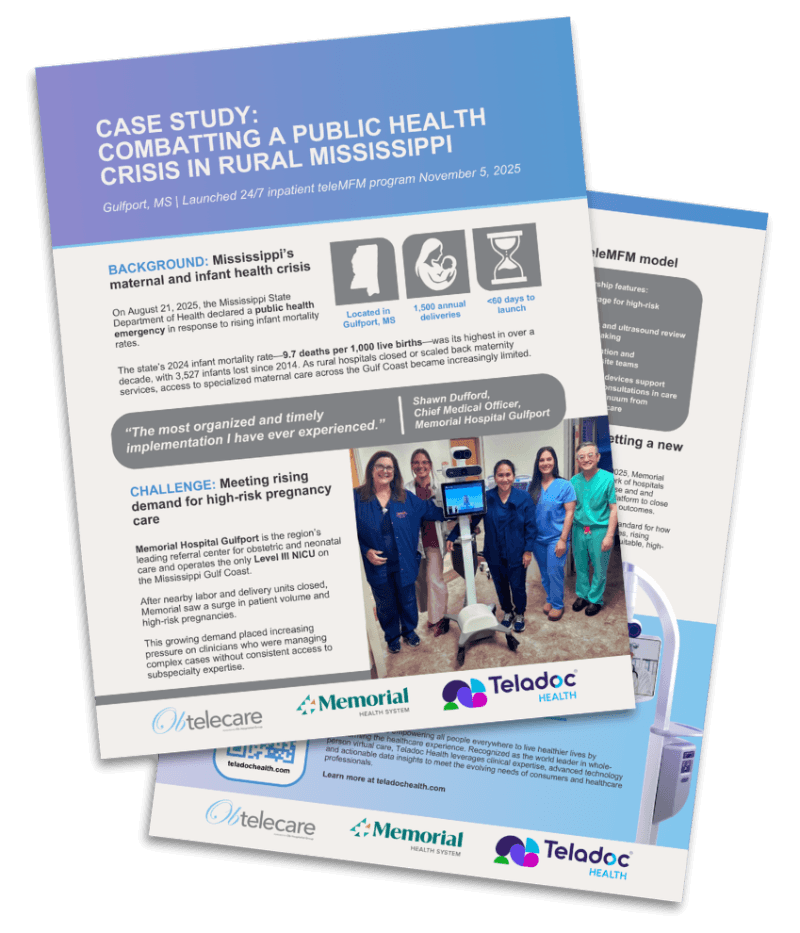
Case study: How a Mississippi hospital launched a telehealth maternal fetal medicine program in under two months
In Mississippi, a state that consistently ranks among the nation’s worst in both maternity care access and preterm births, leaders at Memorial Hospital Gulfport worked with Obtelecare to launch a 24/7 inpatient teleMFM program in under 60 days.
Today, they’re expanding access to high-risk pregnancy expertise amid rising patient volumes and statewide maternal health challenges, while also supporting the region’s only Level III NICU.
Why partner with Obtelecare for the RHT program
Obtelecare is part of Ob Hospitalist Group (OBHG), the nation’s only dedicated OB hospitalist provider with a 20-year clinical reputation and a strong track record in quality and safety metrics.
Unlike many other telehealth providers, we’re founded and directed by clinicians with deep knowledge and passion for improving maternal-fetal outcomes.
That means:
- Deep clinical expertise in maternal safety and emergency care
- Proven protocols implemented in hospitals nationwide
- Experience partnering with health systems and states
- A commitment to culture, collaboration and outcomes
We offer a fully integrated maternal care strategy backed by over 2,000 clinicians and trusted by hospitals throughout the U.S.

For maternal health especially, telehealth technology offers a rare opportunity to address complications earlier, bringing life-saving expertise to communities that have gone without accessible care for decades.